
Treatment-resistant depression can reduce employee productivity for years before patients receive effective care, creating hidden economic costs that extend well beyond healthcare spending, according to a mental health expert interviewed on the Health Policy Podcast.
Dr. William Sauvé, chief medical officer at Osmind, said many patients with treatment-resistant depression continue working despite symptoms that significantly affect their performance.
“In the clinic, what I can tell you what it looks like, historically for me for the last 15 years, it’s more like 8 medication trials that have not been successful for the patient,” Sauvé said. “These people usually have been suffering from depression without really any significant breaks for a good 10, if not 20 years.”
Sauvé said prolonged illness can affect both cognitive function and workplace performance.
“It’s also very common then to see some fairly significant cognitive impairment,” he said. “And what I mean by that are people who are working but they’re clearly not performing half as well as they could be if they felt well.”
He said the condition contributes to what researchers describe as “presenteeism”—employees who report to work but cannot perform at their full capacity.
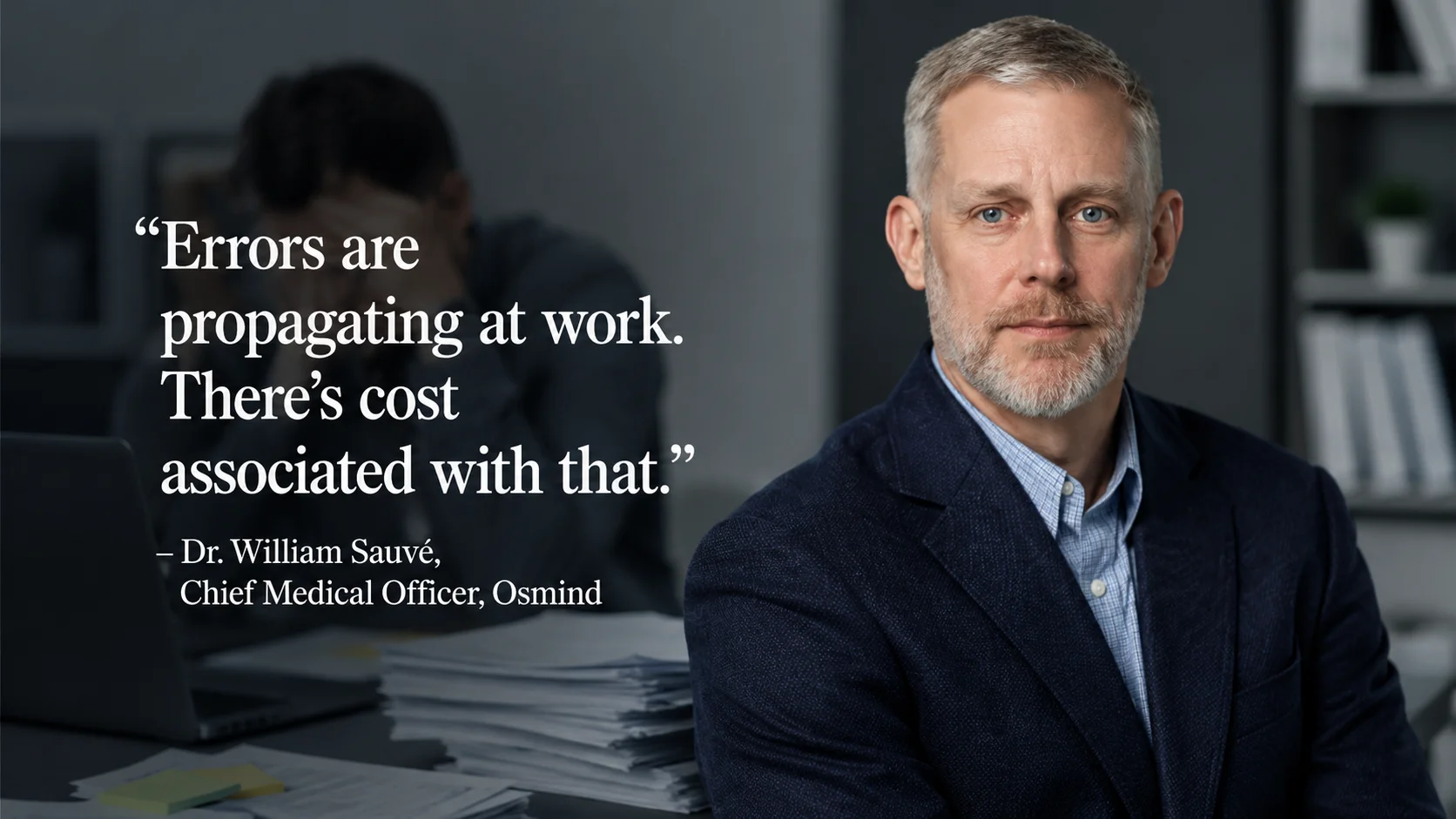
“So there’s this phenomenon that they call presenteeism, right, where we’re not missing work, we’re not on disability, but we’re not moving as fast as we should be,” Sauvé said. “Errors are propagating at work. There’s cost associated with that.”
Sauvé said the effects extend beyond the workplace into patients’ personal lives.
“People have anhedonia. They’re not enjoying their activities. They’re not able to enjoy their off time or their work time,” he said.
As treatment-resistant depression continues over time, he said, patients frequently develop additional medical conditions.
“And then the comorbidity are piling up,” Sauvé said. “It isn’t just the cost maybe of, you know, antidepressant medications, but it’s the cost of potential hospitalizations. But then it’s also a cost of medications for metabolic syndrome and maybe ultimately diabetes and many of the other chronic illnesses that really fly side by side with TRD as the years pile up.”
Mark Desmarais, a principal at Health Management Associates, said a new analysis of Medicare claims data found patients with treatment-resistant depression also generate significantly higher healthcare costs.
“These folks are visiting the hospital more often, visiting the doctor more often,” Desmarais said. “They’re really suffering.”
Desmarais said the condition affects both patients and the healthcare system.
“So it’s having a human impact, but it’s also good to remember that it’s an economic impact, and that should incentivize everyone to really work harder to solve this problem so that we can address the human and economic realities of it,” he said.
Sauvé said intervening earlier may improve outcomes while reducing both personal and economic costs.
“So moving quickly and getting people that life back is of course the thing that I would really, really want to have in mind,” he said.

