
A review of federal campaign contribution records compiled by OpenSecrets shows that several of the nation's largest health insurance organizations directed a larger share of their 2024 contributions to Democratic candidates than Republicans.
An analysis by Patient Daily of OpenSecrets campaign finance data found that Democratic candidates received roughly two-thirds of federal campaign contributions made by UnitedHealth Group, CVS Health, Humana, Cigna, Kaiser Permanente, Centene and organizations within the Blue Cross Blue Shield system during the 2024 election cycle.
Spending by major insurers
• Blue Cross Blue Shield-affiliated organizations collectively: $10.4 million total – Approximately 66% to Democrats, 34% to Republicans.
Affiliated plans and subsidiaries also reported about $27.4 million in lobbying expenses, including entities such as HCSC, Cambia Health Solutions, Elevance Health and GuideWell, according to OpenSecrets.
• Kaiser Permanente: $5.1 million total – Approximately 89% to Democrats, 11% Republicans.
• UnitedHealth Group: $4.47 million total – 57% Democrats, 43% Republicans.
• CVS Health: $2.95 million total – 64% Democrats, 36% Republicans.
• Cigna: $1.81 million total – 54% Democrats, 46% Republicans.
• Centene: $1.81 million total – Approximately 70% to Democrats, 30% Republicans.
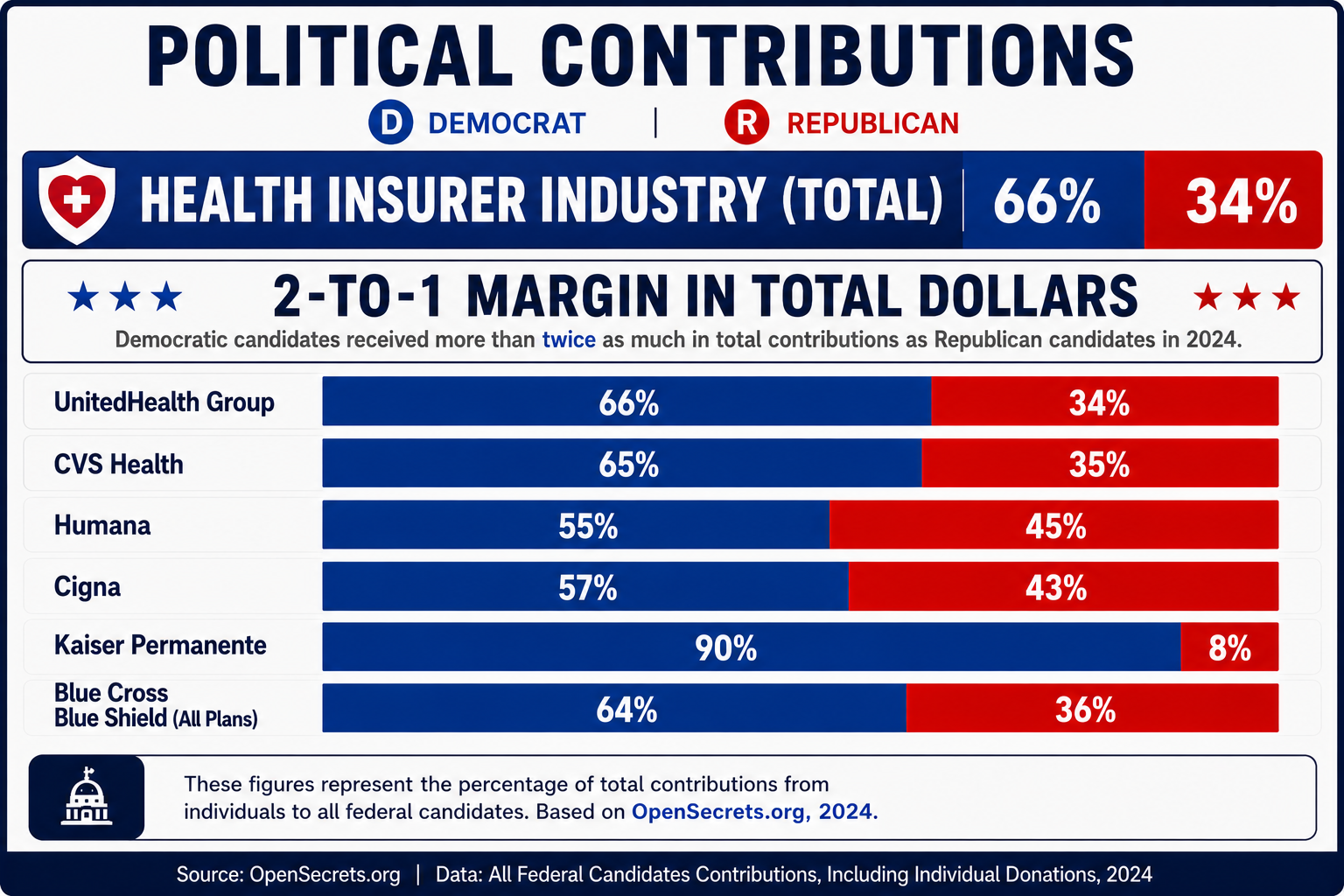
Infographic showing 2024 health insurer political contributions. (Patient Daily)
How healthcare compares with other industries
Major insurers generally describe their political contributions as bipartisan and say they are intended to support candidates involved in healthcare policy rather than endorse a particular political party. UnitedHealth Group, for example, says its PAC considers candidates' positions on healthcare, fiscal issues and committee assignments when making contributions.
Healthcare is one of the highest-spending lobbying sectors in the U.S., with pharmaceutical companies, insurers, and hospitals collectively spending more than $12.9 billion on lobbying since 1998, according to OpenSecrets.
That exceeds other major industries, including electronics manufacturing ($3.66 billion), insurance ($3.8 billion), electric utilities ($3.2 billion), business associations ($3.1 billion) and oil and gas ($3.0 billion), placing healthcare alongside finance, energy and technology as one of Washington's most influential sectors, reported Investopedia.
The industry's influence reflects its exposure to federal policy, including Medicare Advantage, Medicaid managed care, ACA marketplace subsidies, drug pricing rules and insurance regulation, all of which affect insurer revenue, costs and operations. KFF says payment and coverage rules vary across insurer markets and affect overhead and potential profits.
Industry performance backdrop
In 2025, the seven largest health insurers generated nearly $1.7 trillion in revenue and over $54 billion in profits, despite covering about 10 million fewer people than the previous year, according to HEALTH CARE un-covered.
In the decade following the passage of the Affordable Care Act, the combined revenues of the seven largest U.S. health insurers Centene, Cigna, CVS Health/Aetna, Elevance Health, Humana, Molina Healthcare, and UnitedHealth Group tripled, rising from $511 billion in 2014 to $1.52 trillion in 2024, generating a cumulative $10.4 trillion in revenue over the period while their stock performance outpaced the broader market, according to the Economic Policy Innovation Center (EPIC).
EPIC attributes the growth in part to higher premiums, increased out-of-pocket costs and expanded reliance on taxpayer-funded programs like Medicare Advantage and Medicaid. The report also says many insurers expanded vertically integrated businesses, including physician practices, clinics and pharmacy benefit managers.
Key policy priorities
In June 2025 Wendell Potter wrote an article for Writing for HEALTH CARE un-covered titled “Big Insurance Bet on the Wrong Horse” in which he noted the importanc of political engagement for an industry deeply dependent on government programs and regulation.
Potter noted that health insurers focus heavily on Medicare Advantage payment rates, Medicaid contracts, Affordable Care Act subsidies, and insurance market regulations. He added that drug pricing and pharmacy benefit manager regulations have become increasingly important as insurers have expanded through vertical integration.
Other major concerns include prior authorization rules, coverage mandates and transparency requirements, all of which affect administrative costs and profitability.
Consumer advocacy
Consumer groups including Patients for Affordable Drugs, Public Citizen and KFF researchers have argued that regulatory oversight has not kept pace with industry consolidation, particularly regarding prior authorization, pharmacy benefit manager practices and Medicare Advantage payment integrity.
KFF has documented continued consolidation across insurers, physician practices and other healthcare sectors, while policymakers and advocacy groups have raised concerns about the market power of vertically integrated insurers that also own pharmacy benefit managers, physician groups and clinics.
Advocacy organizations have also called for stronger oversight of prior authorization practices, pharmacy benefit manager pricing and Medicare Advantage payments. The Medicare Payment Advisory Commission (MedPAC), the HHS Office of Inspector General and KFF have all published reports identifying concerns in those areas, though they differ on the scope of proposed reforms.
How insurers defend their spending
Insurers argue that lobbying and political contributions are necessary in a heavily regulated industry where government decisions on Medicare, Medicaid, ACA marketplaces and insurance regulations directly affect reimbursement, coverage requirements and business operations.
UnitedHealth Group says its political contributions support candidates based on their positions on healthcare policy, fiscal issues and committee assignments rather than party affiliation.
HEALTH CARE un-covered notes insurers say their engagement provides technical expertise on complex policy issues and helps ensure stability in programs like Medicare Advantage and ACA marketplaces.
Trump administration reform proposals
President Donald J. Trump has proposed “The Great Healthcare Plan,” a set of reforms aimed at lowering drug costs, reducing premiums, increasing transparency and fundamentally reshaping how federal healthcare dollars flow through the system.
A central feature of the plan is redirecting federal insurance subsidies away from insurers and toward individuals, potentially through health savings accounts or direct payments. This would allow consumers to purchase coverage directly, reducing the role of insurers as intermediaries in public programs.
“The Great Healthcare Plan stops sending big insurance companies billions in extra taxpayer-funded subsidy payments and instead send that money directly to eligible Americans to allow them to buy the health insurance of their choice,” Whitehouse.gov’s “The Great Healthcare Plan” landing page reads.
To further reduce costs, the plan targets pharmacy benefit managers, which it argues add unnecessary markups through opaque rebate systems.
On transparency, the plan would require insurers and providers to publish simplified, plain-language disclosures of pricing, coverage, claim denials, administrative costs and profit margins.
“The Great Healthcare Plan creates the ‘Plain English Insurance’ Standard by requiring health insurance companies to publish rate and coverage comparisons upfront on their websites in plain English—not industry jargon,” Whitehouse.gov notes.
Hospitals and insurers participating in Medicare or Medicaid would also be required to publicly post pricing and fee information to improve cost visibility for patients.
“The Great Healthcare Plan requires any healthcare provider or insurer who accepts Medicare or Medicaid to prominently post their pricing and fees in their place of business,” Whitehouse.gov reports.
Overall, the plan combines subsidy restructuring, drug pricing reform, pharmacy benefit manager oversight and expanded transparency requirements with the stated goals of increasing competition, reducing healthcare costs and directing federal insurance subsidies to consumers rather than insurers.

